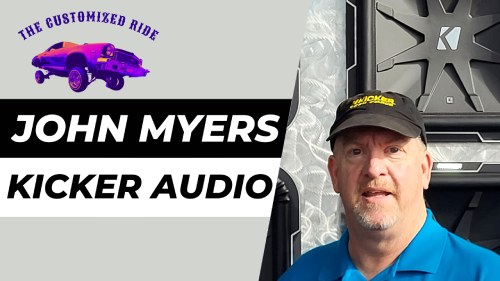
For decades, John Myers has been one of the industry's most recognizable educators in aftermarket mobile electronics. His extensive background spans automotive mechanics, woodworking, upholstery, welding, lighting, fabrication, electronics, and installation, giving him a rare understanding of nearly every discipline involved in building high-quality custom vehicles.
As Senior Global Trainer for KICKER Car Audio, Myers serves as a bridge between engineering, dealers, installers, and enthusiasts. His role isn't simply to teach products—it is to help others understand why products are designed the way they are, how they should be installed, and how proper craftsmanship ultimately creates better experiences for customers.
What makes Myers especially valuable to automotive culture is that his expertise wasn't developed solely in classrooms or boardrooms. It grew from years of hands-on installation, solving real-world problems, learning from mistakes, fabricating custom solutions, and continuously adapting as vehicle technology evolved. Throughout the interview, he demonstrates that experience remains one of the industry's greatest teachers.
Teaching the Industry: How John Myers Turned Curiosity into a Career at KICKER Car Audio
Some people discover their career through careful planning. Others simply keep following what fascinates them until one day they realize they've built a life around it.
For John Myers, that fascination started with discarded speakers.
Long before he became Senior Global Trainer for KICKER Car Audio, Myers was simply a kid who couldn't resist taking things apart. Old speakers headed for the trash became experiments. Cabinets were opened. Drivers were removed. Different locations inside his bedroom became laboratories where he could hear how sound changed depending on placement. He wasn't chasing a profession. He was feeding curiosity.
That curiosity never really stopped.
Instead, it expanded.
Woodworking classes became useful because speaker boxes needed to be built. Drafting classes sharpened his ability to design. Auto mechanics connected him to the vehicles that would eventually become his canvas. Electronics tied everything together.
Looking back, it's easy to see how each interest was preparing him for a career that didn't yet have a name.
Discovering That Passion Could Pay
One Saturday afternoon changed everything.
A neighbor struggled to install a radio in his 1966 Buick Electra. Myers heard the frustration from inside his bedroom and walked outside to help. To him, it looked simple—just five wires.
Within minutes the radio was working.
The neighbor reached into his wallet and handed the young teenager twenty dollars.
For many people it would have been a small payment.
For a thirteen-year-old in 1979, it was a revelation.
People would actually pay him to do something he already enjoyed doing.
That moment transformed a hobby into possibility.
It also introduced him to an industry that was far different from today's installer-friendly environment.
Back then there were no plug-and-play harnesses, molded dash kits, or factory integration modules waiting on store shelves. Every installation required cutting factory wiring. Every dashboard demanded fabrication. Every project forced installers to become mechanics, electricians, fabricators, and problem solvers simultaneously.
For Myers, those challenges weren't obstacles.
They were education.
Learning to Solve Problems Instead of Following Instructions
One of the strongest themes running throughout the conversation is that installation has never been about simply following directions.
It's about solving problems.
Modern vehicles may include custom integration kits, replacement dash panels, factory adapters, and vehicle-specific mounting systems, but Myers reminds listeners that technology has also created entirely new complications. Climate controls, heated seats, steering wheel controls, power windows, cruise control, and countless other functions are now integrated into factory infotainment systems. Replacing a radio is no longer just replacing a radio.
Understanding how everything works together has become just as important as knowing how to wire speakers.
Rather than complaining about those changes, Myers embraces them.
Every vehicle presents another puzzle.
Every puzzle teaches something new.
That mindset has remained remarkably consistent throughout his career.
Why Good Tools Matter
Experience has taught Myers something that every professional eventually learns.
Quality work begins long before the installation starts.
It begins with preparation.
Throughout the interview he emphasizes how dramatically the right tools improve not only the finished product but the efficiency, profitability, and enjoyment of the work itself. Installers who invest in quality equipment aren't simply buying convenience—they're investing in better craftsmanship.
He laughs about today's installers sometimes complaining about installation kits while remembering an era when there were no kits at all.
Compared to those early years, modern installers have access to resources previous generations could only dream about.
His perspective isn't nostalgic.
It's appreciative.
Technology has removed many unnecessary frustrations while allowing installers to focus more attention on quality and creativity.
COVID Changed More Than Anyone Expected
Like nearly every automotive business, KICKER entered unfamiliar territory during the COVID pandemic.
What surprised many people was how differently various parts of the industry were affected.
According to Myers, business actually exploded.
Consumers suddenly found themselves staying home instead of traveling. Entertainment budgets shifted. Stimulus money entered the economy. Many enthusiasts redirected disposable income toward improving their vehicles, creating extraordinary demand for aftermarket audio products. KICKER couldn't manufacture products fast enough to keep up.
Professionally, however, Myers faced a completely different challenge.
As a global trainer, his career depended on face-to-face interaction.
Dealer visits.
Hands-on demonstrations.
Live classroom environments.
Car shows.
Industry events.
Those experiences suddenly disappeared.
Virtual presentations kept training alive, but they couldn't replace reading an audience's reactions, answering spontaneous questions in person, or walking through products together on a showroom floor.
His comments capture an important chapter of automotive history that many future enthusiasts may overlook.
The products continued moving.
The relationships had to evolve.
The Best Education Still Happens at Car Shows
Despite decades of experience, Myers doesn't speak like someone who believes he has mastered the industry.
Instead, he sounds like someone still learning.
One reason he enjoys returning to live events is simple.
Every show teaches him something.
No matter how many builds someone has seen, another builder will arrive with an idea nobody expected.
Another fabrication technique.
Another creative solution.
Another perspective.
"You'll never see it all," he explains, emphasizing that automotive creativity continually reinvents itself.
That willingness to remain a student may be one of the defining characteristics of his career.
Excellence Is Built One Idea at a Time
When asked to identify the greatest build he's ever seen, Myers resists choosing only one.
Instead, he reveals something deeper about his design philosophy.
Every project contributes something.
Rather than copying another builder's work, he prefers collecting ideas from many different vehicles before combining them into something original.
Innovation, in his view, rarely arrives fully formed.
It grows through observation.
Learning.
Experimentation.
Continuous refinement.
That philosophy mirrors his own career.
Every class.
Every installation.
Every television build.
Every dealer visit.
Every mistake.
Every success.
Each experience became another piece of knowledge that could be applied somewhere else.
Building More Than Better Sound
Although Myers works for one of the world's most recognized audio manufacturers, the interview rarely feels like a discussion about speakers or amplifiers.
Instead, it becomes a conversation about craftsmanship.
Curiosity.
Problem solving.
Continuous education.
Helping others become better at what they do.
Those qualities ultimately define his contribution to automotive culture.
Technology will continue changing.
Vehicle electronics will become more complex.
Products will evolve.
Installation techniques will improve.
But the mindset Myers represents—remaining curious enough to keep learning—will likely remain just as valuable decades from now as it was when he first picked up those discarded speakers.
That may be the most important lesson his story leaves behind.
John Myers isn't simply helping people install better audio systems.
He's helping preserve a culture where craftsmanship, knowledge, and lifelong learning still matter.
Seven Lessons From John Myers of Kicker Car Audio
Lesson 1: Curiosity Can Become Your Career
Most careers don't begin with a master plan. They begin with curiosity.
For John Myers, that curiosity started by taking apart discarded speakers, experimenting with sound, and exploring how things worked. Those early experiments weren't done to build a résumé—they were driven by genuine interest. Over time, woodworking, drafting, mechanics, and electronics naturally merged into a profession that allowed him to use every one of those skills.
His story reminds us that hobbies shouldn't always be dismissed as distractions. Sometimes they're clues pointing toward work we were meant to do. The activities that consistently hold our attention often reveal strengths we don't yet recognize.
Too many people search for the perfect career without first paying attention to what naturally excites them. Myers' journey shows that passion often comes before the profession, not after it.
Key Takeaway: Your greatest career opportunities may begin with the things you already enjoy doing.
Lesson 2: Great Problem Solvers Never Stop Learning
Technology changes.
Vehicles change.
Customer expectations change.
The people who succeed are those willing to keep adapting.
Throughout the interview, Myers never presents himself as someone who has mastered everything. Instead, he repeatedly talks about learning at car shows, seeing new ideas from builders, and facing different challenges with every vehicle. Even after decades in the industry, he approaches every project with the mindset of a student.
That humility is one of his greatest strengths.
Knowledge isn't a destination—it's a continuous process.
Whether someone works in automotive, healthcare, education, or business, industries evolve. Those who stop learning eventually find themselves solving yesterday's problems with yesterday's solutions.
Key Takeaway: Expertise isn't knowing everything—it's remaining willing to keep learning.
Lesson 3: Invest in the Right Tools
One of Myers' simplest observations carries surprisingly broad wisdom.
"The right tools make the job better."
In automotive work, better tools improve quality, efficiency, and consistency.
The same principle applies everywhere else.
Sometimes the "tool" is software.
Sometimes it's education.
Sometimes it's mentorship.
Sometimes it's better communication skills.
People often hesitate to invest in resources that make them better because they only see the upfront cost. Myers encourages a different perspective.
Good tools save time.
Reduce frustration.
Increase quality.
Create better outcomes.
Those benefits compound over years.
Key Takeaway: Investing in quality tools is really investing in yourself.
Lesson 4: Every Challenge Creates Opportunity
COVID created enormous uncertainty throughout the world.
For KICKER, it also created unexpected opportunity.
As Myers explains, people redirected entertainment and travel spending into their vehicles, causing aftermarket audio demand to surge. At the same time, his own job changed dramatically as live training shifted online.
He experienced both growth and disruption simultaneously.
That's often how life works.
Few circumstances are entirely positive or entirely negative.
Successful individuals learn to identify opportunities hidden inside difficult situations while honestly addressing the challenges those situations create.
Adaptability becomes a competitive advantage.
Key Takeaway: The people who thrive aren't those who avoid change—they're those who learn how to respond to it.
Lesson 5: Relationships Matter More Than We Think
Toward the end of the interview, Myers discusses something that extends far beyond automotive work.
Knowing the right people matters.
He enjoys learning from builders.
He appreciates experienced fabricators.
He values industry friendships.
And he openly acknowledges that even experienced professionals sometimes need to call someone else for help.
That perspective challenges the myth that successful people do everything alone.
Strong careers are rarely built in isolation.
They're built through trust, shared knowledge, and mutual respect.
The strongest professional networks aren't collections of business cards.
They're communities.
Key Takeaway: Relationships often solve problems that knowledge alone cannot.
Lesson 6: Quality Is Worth Waiting For
One discussion focuses on long vehicle build times.
Three years at an upholstery shop.
Six-year restoration projects.
Long waits for specialized parts.
Rather than criticizing those timelines, Myers explains that allowing skilled craftsmen the time to do excellent work often produces better results than rushing projects simply to meet deadlines.
In today's culture of instant gratification, that perspective feels refreshing.
Some things simply cannot be rushed.
Craftsmanship.
Mastery.
Trust.
Reputation.
Meaningful success usually develops slowly.
Trying to speed every process often produces work people quickly forget.
Key Takeaway: Lasting quality usually requires patience.
Lesson 7: Build Something That Lasts
Although Myers spends the interview discussing products, installations, and vehicles, the deeper message is about building things that continue creating value long after the work is finished.
Every installation teaches another lesson.
Every customer becomes another relationship.
Every project contributes another idea.
Every generation of installers benefits from the knowledge shared by those who came before them.
That's legacy.
His career demonstrates that lasting impact isn't measured only by products sold or vehicles completed.
It's measured by people helped.
Knowledge shared.
Craftsmanship preserved.
Future professionals equipped to continue improving the industry.
Key Takeaway: The greatest careers leave behind knowledge that continues helping others.
Top 5 Quotes
1.
"If you love what you do, you'll never work a day in your life."
2.
"You'll never see it all, even if you go to every event."
3.
"I take bits and pieces from everything else and combine it in a different way to make something totally new and different."
4.
"Having the right tools makes the job better, it makes it go quicker, and they make you more money in the long run."
5.
"You have to be a problem solver... it's something different every time. It's a challenge, and that's what I like."