
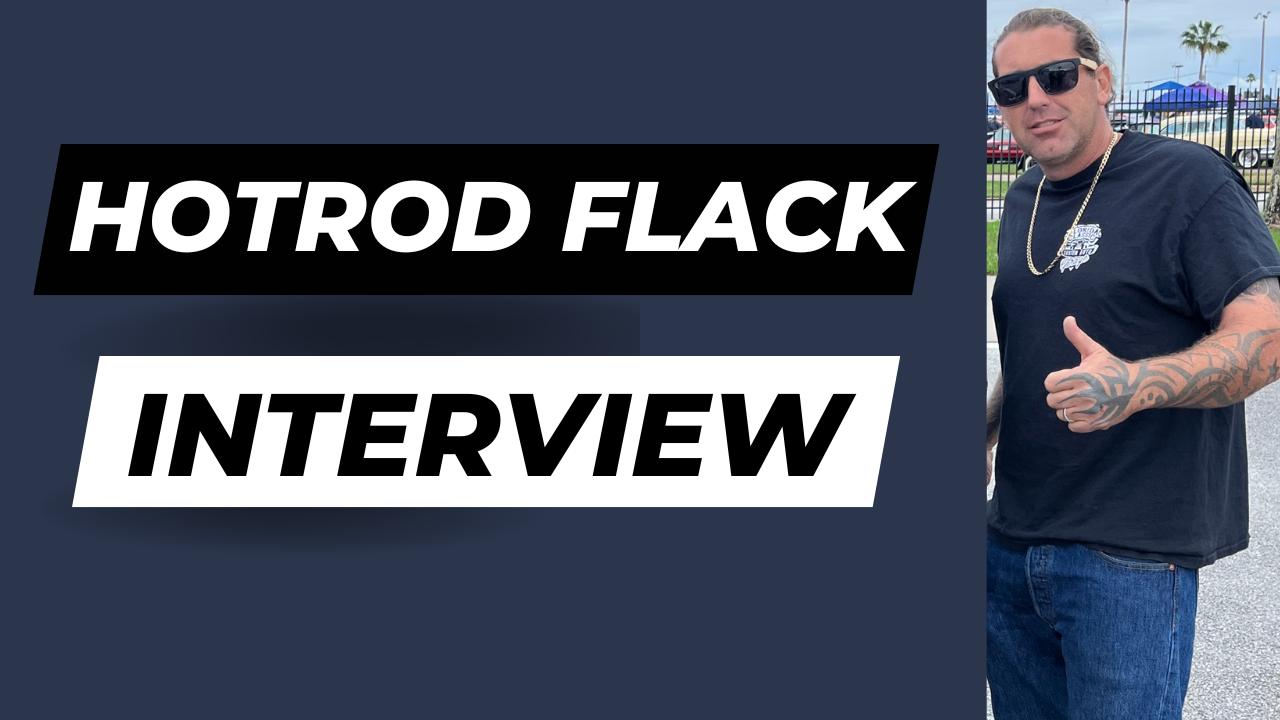
Hotrod Flack is an automotive trader, builder, entrepreneur, and emerging content creator whose experience spans nearly every part of a vehicle and nearly every stage of a deal. Introduced to mechanical work during childhood on his uncle’s farm, he learned by reviving old vehicles with the promise that anything he could get running could be driven. That early combination of problem-solving, freedom, and machinery developed into a lifelong attachment to hot rods, classic trucks, and the culture surrounding them.
Flack is especially known for his participation in the automotive trading world at major events such as the Daytona Rod Run and the Pigeon Forge Rod Run. He may arrive with one vehicle and complete numerous trades before the event ends, sometimes never driving the vehicles that briefly pass through his possession. His experience includes restoration, wiring, engines, transmissions, steering systems, air conditioning, rear ends, vehicle evaluation, negotiation, and relationship-driven automotive business. He is now developing a media concept built around traveling, trading cars, completing selected builds, recording conversations, and documenting a side of automotive culture rarely seen by outsiders. His story matters because it preserves not only the vehicles, but also the risks, unwritten rules, personalities, and human relationships that keep the traditional trading world alive.
Built for the Next Deal: Inside Hotrod Flack’s World of Cars, Risk and Handshake Trading
Before Hotrod Flack learned the language of trade values, cash differences, restoration costs, social-media reach, or automotive content, he learned something simpler:
If he could make an old vehicle run, he could drive it.
The offer came from his uncle, whose farm contained the kind of mechanical landscape that can shape an automotive enthusiast for life. There were dune buggies, Corvettes, old trucks, and vehicles sitting out back in various states of disrepair. Flack spent considerable time there during childhood, partly because he had a tendency to find trouble.
His uncle handled discipline differently.
Instead of grounding him, he gave him yard work.
The farm also gave him machinery.
“If you get them running, you can drive them,” his uncle told him.
Most of the vehicles had manual transmissions, creating another challenge after the engine finally came to life. Flack would get one running, attempt to drive it, and immediately stall it.
His uncle’s advice was not delicate.
Hold the accelerator down, release the clutch, and do not let off.
It was a rough introduction to driving, but it placed the experience permanently in Flack’s blood. Cars were not distant objects to admire. They were problems to solve, machines to revive, and opportunities to earn freedom.
He eventually entered construction and remained there for years, but the automotive pull never disappeared. Cars had been woven too deeply into his identity.
The mechanical side was only half of the story.
Flack was also fascinated by the possibility of turning one object into another.
He remembers hearing the story of a person who began with a small item—commonly remembered as a paperclip—and traded repeatedly until eventually receiving a house. The specific object mattered less than the lesson Flack took from it.
“If somebody could trade something for a house, I could trade anything for anything.”
He began with bicycles, skateboards, and ordinary childhood belongings.
The habit never stopped.
The Introduction That Changed Everything
Flack’s involvement grew significantly after purchasing his first T-bucket and attending the Daytona Rod Run.
There, he met a man he identified as Phil B.
Phil introduced him to people.
Those people introduced him to more people.
The network expanded until, in Flack’s words, it “created an animal.”
That description captures the intensity of his relationship with trading. Vehicles enter his life with promises of permanence. He tells himself that the newest arrival is finally the keeper—the model he has wanted for years and will never sell.
Then someone makes the right offer.
The supposedly permanent vehicle disappears.
Trading is not merely a strategy Flack uses to acquire cars. It is part of the experience he enjoys. The uncertainty creates excitement. The next conversation may lead to a better vehicle, needed cash, a future opportunity, or a deal he will regret before the day is over.
At major shows, the pace can become difficult for outsiders to imagine.
Flack explained that he may complete fifteen or twenty trades at events such as the Daytona Rod Run or the Pigeon Forge Rod Run. In some cases, one person delivers a vehicle to his space and another person removes it shortly afterward.
He may technically own the car without ever driving it.
The process resembles a moving marketplace where every vehicle is both a possession and a possible form of currency.
A trader may arrive with a car worth approximately $16,000 and encounter someone with a truck worth around $12,000. If the second owner adds $4,000, the theoretical values become equal. Yet the final agreement may involve only $2,000 because Flack wants cash available for the next opportunity.
That flexibility is essential.
A vehicle does not possess one universal value that remains fixed throughout the event. It has a retail value, a trade value, a cash value, and a situational value shaped by what each owner needs at that moment.
Someone may hold a $25,000 car because he has no financial pressure.
After trading it, the next owner may need money immediately and sell it for $12,000.
The car did not physically change.
The owner’s circumstances did.
Those shifting motivations create opportunities that cannot always be explained through price guides alone.
When the Deal Goes Backward
Opportunity carries risk, and Flack does not pretend every trade has worked in his favor.
One lesson arrived through a beautiful black 1971 Chevrolet stepside pickup. The truck had a small-block engine, power steering, power brakes, and a level of cleanliness that made nearly every surface appear finished.
An older trader approached Flack wanting the truck and offered a coupe he described as being in mint condition.
Flack saw the coupe from a distance.
He did not thoroughly inspect it.
He accepted the description.
Believing the pickup was worth approximately $30,000 and the coupe around $20,000, Flack initially requested $10,000 in additional cash. They eventually agreed on $7,000.
The money changed hands.
The vehicles changed owners.
The deal was sealed with a handshake.
Then Flack entered the coupe.
The car started.
The engine ran.
He placed it in drive, and it did not move.
The rear end was destroyed.
Flack returned to the other trader and demanded the additional money he had originally requested. The answer was simple: a deal was a deal.
There was no return policy.
No second negotiation.
No rescue from the consequences of failing to inspect the car.
The coupe would only move in reverse, forcing Flack to back it down the street toward his space.
The story is funny in retrospect, especially when told through Flack’s animated personality, but it became one of the clearest lessons in the interview.
Responsibility begins before the handshake.
A buyer who has concerns must investigate them before completing the agreement. Once the trade is final, anger does not replace due diligence.
Flack does not excuse dishonesty, but he accepts that the trading environment places responsibility on every participant.
“Once you shake someone’s hand, that’s it,” he explained.
The Cars We Did Not Know to Keep
Nearly every longtime automotive enthusiast carries at least one story about a vehicle sold before anyone understood what it might eventually become.
During the conversation, Chris shared one of his own.
When he was 18, his father owned a 1970 Chevrolet Chevelle Super Sport. His father gave him a choice: Chris could keep the car, or his father could sell it to one of Chris’s friends for $500 and give Chris the money.
Chris chose the money.
At the time, the decision did not seem unreasonable. The Chevelle was simply an older car, and neither Chris nor his father could have predicted how dramatically the value of desirable muscle cars would rise in the decades ahead.
Looking back, the decision is difficult to comprehend. A car that changed hands for $500 could now be worth tens of thousands of dollars.
Chris’s story opened a larger discussion about the classic vehicles people sold, traded, neglected, or passed over before the automotive market recognized their significance. It is a regret shared by an entire generation that remembers many of today’s most valuable collector cars when they were still ordinary used vehicles.
The conversation then moved into the practical challenge of preserving classic cars.
Buying one is only the beginning.
Storage requires space. Humidity can damage interiors. Mold can develop even inside a large building when air is not circulated properly. Climate control, maintenance, cleaning, insurance, repairs, and long-term care all require money.
The idea of buying inexpensive classics, storing them for decades, and eventually benefiting from their appreciation may sound simple. In reality, an owner must be able to preserve the vehicle long enough for its future value to matter.
Starting With Nothing but the Vehicle
Flack’s account of automotive trading was not built entirely around large budgets.
He has attended events with no cash available, depending on his ability to make an early trade that produced money. He would trade down shortly after arriving, place several hundred or several thousand dollars in his pocket, and then use the replacement vehicle to begin trading upward again.
That process required resourcefulness.
“You can start with a couple thousand bucks,” he explained, describing a world with multiple levels of participation.
People trade expensive classics, but they also exchange lower-cost vehicles, scooters, equipment, parts, and other objects. Someone does not need to begin with the best car at the event.
He needs something another person wants.
Flack has met wealthy collectors, struggling enthusiasts, experienced traders, and newcomers attempting their first deal. He has watched people with limited money find ways to participate because they were willing to work, negotiate, and remain creative.
“I’ve been that guy,” he said.
That admission gives his advice credibility.
He is not describing resourcefulness as a theory. He remembers arriving without money and depending on his ability to create an opportunity before the weekend ended.
Why the Same Car Carries Different Numbers
One of the most useful sections of the interview involved Flack’s explanation of pricing at major trading events.
Visitors sometimes see a vehicle displaying a number far above what they believe the car should sell for. They assume the seller is unrealistic.
Flack explained that the posted number may be a trade number rather than the amount the owner expects in cash.
A person may display $42,000 on a car but accept $30,000 in cash. The higher number creates room when exchanging it for another vehicle whose displayed price may also exceed its cash value.
Problems emerge when someone asks for the lowest cash price and then attempts to use that reduced number as the basis for a trade.
The seller may be willing to accept $30,000 cash because cash creates immediate flexibility. That does not mean the seller will value another person’s vehicle at full retail while reducing his own to the cash figure.
The difference explains why negotiations at shows can appear confusing from the outside.
Cash removes uncertainty.
A trade introduces another vehicle, another condition assessment, another market, another repair risk, and another sale that must eventually occur.
The owner accepting the trade needs room to absorb those unknowns.
Timing also matters.
At the beginning of an event, inventory is fresh. Traders are reluctant to accept low cash offers because they still have several days to find a stronger deal. Near the end, priorities change. Many participants do not want to take the same vehicle home.
The price begins falling because the remaining time has become part of the negotiation.
Craftsmanship Versus Volume
Flack’s future may involve fewer vehicles rather than more.
He has spent enough time around automotive businesses to understand the temptation of volume. A shop may fill with twenty projects because each one represents potential revenue.
The problem is that every additional project introduces scheduling pressure, staffing needs, storage issues, customer expectations, quality-control demands, and the possibility that small mistakes will damage expensive vehicles.
Flack believes his own skills cover nearly every area of a build. He discussed engines, wiring, air-conditioning systems, steering, rear ends, transmissions, and other components. He is confident in the work he performs personally.
His challenge has been finding the right group of people to work beside him.
He acknowledged that talented automotive professionals exist and spoke positively about people who had worked for him. The difficulty was finding a dependable local team with the versatility, care, and consistency required to protect his standards across multiple builds.
He does not want a finished vehicle leaving with careless wiring, a poorly aligned pulley system, damaged paint, or work he would be unwilling to put his name behind.
That realization changed his vision.
Instead of building a high-volume operation, Flack wants to complete a smaller number of projects and turn the process into media.
The build itself would generate revenue.
The content surrounding the build would create another asset.
The customer would receive a vehicle.
The audience would receive a story.
Turning a Kodiak Into a Traveling Studio
Flack’s future plans combine nearly every part of his personality.
He wants to build cars, trade cars, travel, operate a dealership, interview people, record podcasts, create social-media content, and eventually develop a television-style automotive program.
A large Kodiak truck sits at the center of the idea.
Flack described the truck as a semi-style vehicle fitted with large military wheels and tires. He intends to outfit it for podcasting and use exterior cameras to document automotive deals. With a two-car or three-car trailer attached, the truck could become a mobile headquarters capable of moving from one major event to another.
The concept reflects how automotive media has changed.
A person no longer needs to wait for a television network to approve a series. Social platforms allow an independent creator to document the experience, build an audience, test ideas, attract partners, and gradually develop a format.
Flack has already experienced part of that world through an appearance with Ted Vernon and South Beach Classics. He described the experience as closely matching what he wants from life: buying, selling, trading, operating a dealership, restoring selected vehicles, and sharing the experience with viewers.
The goal is not to abandon the traditional car world.
It is to bring cameras into it.
The Code Behind the Chaos
From the outside, automotive trading can resemble uncontrolled deal-making.
Flack sees a structure beneath it.
The structure is reputation.
A handshake matters.
Loyalty matters.
Respect matters.
Personal value matters.
A trader should attempt to sell good vehicles rather than knowingly pass every problem to the next person. A buyer must accept responsibility for inspecting what he purchases. People should remember who treated them fairly.
Flack explained that if another trader gives him the favorable side of one deal, he tries to return that consideration during a later transaction. Not every vehicle allows that flexibility. Sometimes a trader has too much money invested and cannot afford to give anything away.
But over time, the balance matters.
Relationships create future access.
A person who attempts to win every exchange at everyone else’s expense may discover that the larger network stops inviting him into opportunities.
That is the deeper lesson behind Flack’s stories.
The cars continuously change.
The reputation stays with the person.
More Than the Vehicle in the Space
Hotrod Flack’s story cannot be reduced to a list of vehicles he has owned.
The list would be outdated almost immediately.
His importance comes from the way he moves through automotive culture—repairing, trading, risking, learning, laughing, losing, recovering, and preparing for the next possibility.
He grew up around vehicles that had to be earned through work.
He entered trading because he believed one object could become something greater.
He built relationships that expanded his world.
He made costly mistakes and accepted the lessons.
He developed broad mechanical ability but became wary of allowing volume to weaken craftsmanship.
Now he is attempting to preserve the experience through media.
Years from now, people may remember individual vehicles: the 1971 C10 tattooed on his arm, the coupe that only moved backward, the childhood Chevrolet that defeated his cousin’s Ford during a family tug-of-war, or the Kodiak transformed into a rolling studio.
The greater contribution will be the world those vehicles reveal.
It is a world where a broken truck can become a childhood education, an introduction can create a career network, a handshake can carry more weight than paperwork, and the vehicle sitting in front of someone may only be the beginning of the next deal.
Seven Lessons From Hotrod Flack
Lesson 1
The Opportunity Is Often Hidden Inside the Problem
Flack’s earliest automotive experiences did not begin with perfectly restored vehicles.
They began with broken ones.
His uncle’s farm contained trucks, dune buggies, Corvettes, and other machines that had stopped working. To some people, they may have looked like abandoned problems. To a mechanically curious child, each vehicle represented a possible reward.
If Flack could make it run, he could drive it.
That arrangement taught him to look at broken things differently. The condition in front of him was not necessarily the final condition. A vehicle that could not move might become transportation, entertainment, education, or a new memory if he could identify what was wrong and find a solution.
That mindset later extended into business.
A vehicle another person no longer wanted could become an opportunity. A low-value trade could create needed cash. A poorly presented car could become more desirable after repairs. A failed business model could lead toward a media concept better aligned with his strengths.
Resourceful people do not ignore problems. They examine them for hidden possibilities.
This does not mean every broken vehicle should be purchased or every difficult situation should be accepted. Some problems cost more to repair than they are worth. Flack’s coupe with the destroyed rear end demonstrated that clearly.
The lesson is to develop the ability to distinguish between a problem containing opportunity and a problem containing only unnecessary risk.
That discernment grows through experience.
Key Takeaway: A problem becomes an opportunity only when you understand what it will take to change its condition.
Lesson 2
One Introduction Can Change the Direction of a Life
Flack’s involvement in automotive trading expanded after Phil B. introduced him to people at the Daytona Rod Run.
Those introductions led to more introductions.
The immediate value was not a vehicle, check, contract, or sale. It was access.
Someone already established in the community allowed Flack to enter circles that would have taken much longer to reach alone.
This is how many industries truly operate.
Public success appears to be built on talent, products, money, or marketing. Behind those visible elements are often relationships that began because one person trusted another enough to make an introduction.
The person creating the connection may never fully understand its impact.
Phil may have believed he was simply helping another enthusiast meet people at an event. For Flack, those introductions helped create a lifelong trading network and influenced the direction of his automotive identity.
The lesson applies to both sides of the relationship.
A newcomer should value the people willing to open doors.
An established person should not underestimate what can happen when he helps someone deserving enter the room.
Introductions are not merely exchanges of names. They are transfers of trust. When someone respected introduces another person, part of that reputation temporarily travels with the newcomer.
That opportunity should be treated carefully.
Key Takeaway: Sometimes the most valuable thing someone can give you is access to the people who will shape your next chapter.
Lesson 3
A Handshake Does Not Remove the Need for Due Diligence
Flack’s story about the coupe that only moved in reverse contained two truths that must be held together.
First, people should be honest.
The seller’s description of the car as being in mint condition did not match the mechanical reality Flack discovered.
Second, the buyer still has a responsibility to inspect what he is acquiring.
Flack accepted that responsibility. He was angry, but he recognized that he had completed the trade without fully examining the car. Once the agreement was made, the community’s expectation was that both people would stand behind the handshake.
Trust and verification are not enemies.
A person can respect another party while still inspecting the vehicle, reading the agreement, reviewing the numbers, asking difficult questions, and checking the important details.
Inexperienced people sometimes avoid due diligence because they fear appearing distrustful. They believe questions will offend the seller or damage the relationship.
A healthy transaction should survive reasonable examination.
When large amounts of money, time, or responsibility are involved, refusing to investigate is not an act of kindness. It is an unnecessary surrender of responsibility.
This lesson applies far beyond vehicle trading.
Business partnerships, employment agreements, investments, property purchases, service contracts, and personal commitments all require some form of evaluation.
A handshake should confirm that both sides understand the agreement.
It should not replace the work necessary to understand it.
Key Takeaway: Trust the person when appropriate, but always inspect the deal.
Lesson 4
Price Is Shaped by Circumstances, Not Just Value
Flack explained that the same car may be held for $25,000 by one owner and sold for $12,000 by the next.
The difference may have little to do with the vehicle.
One owner does not need money and can wait.
Another needs cash immediately.
The second owner’s circumstances create an opportunity for a buyer.
This distinction between value and price appears throughout life.
A business may be valuable but sold cheaply because the owner needs to exit.
A property may be discounted because of timing.
A talented employee may accept less than his market value because he needs stability.
A collectible may sit unsold at a high price for years because the owner has no reason to negotiate.
Price is the number attached to a particular transaction at a particular moment.
Value is a broader judgment about what the item is worth under normal or ideal circumstances.
Confusing the two can lead to poor decisions.
Someone may assume a low price automatically means poor quality. Another may believe a high asking price proves high value. Neither conclusion is reliable without understanding the circumstances.
Flack’s trading approach depends on recognizing motivation.
The vehicle matters, but so does the person holding it.
The best negotiators listen for both.
Key Takeaway: To understand the price, study the circumstances surrounding the person who controls the asset.
Lesson 5
More Work Can Produce Less Quality
Flack’s resistance to volume reveals an important business truth.
Growth creates complexity.
A shop with two active projects may allow the owner to remain involved in every detail. A shop with twenty projects requires more employees, stronger systems, greater storage, more communication, more cash flow, additional suppliers, and constant scheduling.
Revenue may increase while control decreases.
Many entrepreneurs assume that growth means accepting more customers, adding more services, hiring more people, and filling every available space.
Flack recognizes that this kind of growth may move him away from the work he values.
He wants finished vehicles to reflect his standards. He does not want poor wiring, damaged paint, mechanical shortcuts, or rushed assembly attached to his name.
The problem is not that other people are incapable of quality work. The problem is that maintaining consistent standards across a larger team requires leadership systems that are different from personally performing the work.
Some business owners genuinely want to build those systems.
Others are happier remaining closer to the craft.
Neither path is automatically superior.
The mistake is pursuing scale because success is commonly measured by volume rather than alignment.
A smaller operation can produce meaningful income, excellent work, strong relationships, and a respected reputation. A larger operation can also accomplish those things, but only when its systems grow as quickly as its workload.
Key Takeaway: Do not expand the workload faster than your ability to protect the standard.
Lesson 6
The Best Deal Is Not Always the One Where You Take the Most
Flack described trying to remember the people who gave him favorable terms.
When possible, he attempts to return the advantage later.
This is not charity. It is relationship-based business.
A person focused only on the current transaction attempts to extract the maximum amount immediately. A person focused on the long term asks whether both sides will want to work together again.
There will be situations where financial limitations prevent someone from giving ground. Flack acknowledged that a trader may have too much invested in a particular car to offer an unusually favorable deal.
Reciprocity does not require ignoring reality.
It requires remembering generosity and responding when the opportunity becomes available.
This creates a different kind of market.
Instead of every negotiation being an isolated conflict between buyer and seller, transactions become part of a longer relationship. One person may do better today. The other may benefit next time. Trust grows because both believe the relationship is larger than one piece of inventory.
The principle applies in business, leadership, friendship, and community.
People remember those who treated them fairly when they had the power to take advantage.
They also remember those who attempted to win everything.
Key Takeaway: A deal that strengthens the relationship may ultimately be worth more than the maximum profit from one transaction.
Lesson 7
Experience Becomes More Valuable When It Is Preserved
Flack has accumulated stories that could easily disappear.
He remembers learning to repair vehicles on his uncle’s farm, entering the trading community through Phil B., making fifteen or twenty trades at a show, losing money, buying former vehicles again, watching automotive values change, building businesses, searching for the right team, and learning the unwritten rules of the trade.
Without documentation, those experiences remain limited to the people who hear them in person.
His media vision could change that.
By recording builds, negotiations, road trips, interviews, successes, and mistakes, Flack can turn personal experience into a resource for other enthusiasts.
The entertainment value is obvious.
Audiences enjoy unexpected deals, unusual cars, mechanical failures, arguments, major wins, and behind-the-scenes access.
The historical value may be even greater.
Automotive culture has always depended heavily on oral history. People learn from conversations at shows, garages, swap meets, and shops. As generations pass, many stories disappear because nobody formally records them.
Independent creators now possess tools that previous generations did not.
A mobile phone, camera, podcast setup, or social platform can preserve experiences once limited to memory.
Flack’s Kodiak concept represents more than a content strategy. It could become a traveling archive of the people and transactions that keep automotive culture moving.
Key Takeaway: Knowledge creates a legacy only when someone takes the time to preserve and share it.
Top 5 Quotes
-
“Once you make a deal out there, you made it. Once you shake someone’s hand, that’s it.”
-
“If somebody could trade something for a house, I could trade anything for anything.”
-
“Sometimes you trade into the gem. You just never know.”
-
“Goals are achievable. Projects sometimes never get finished.”
-
“It’s up to you to make sure you’re not getting burned in life. Look your cars over and make sure they’re good.”
